
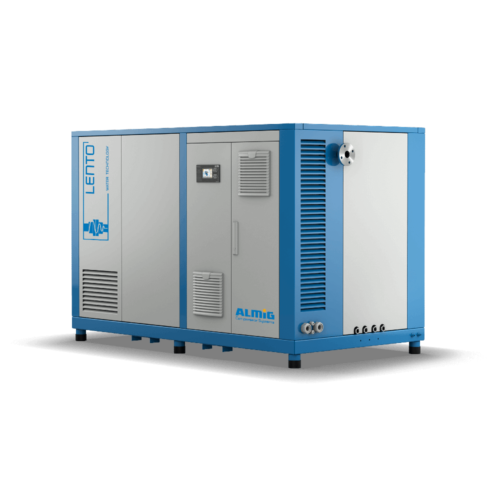
Choosing between a standard rotary screw compressor and an oil-free rotary screw compressor is one of the most important decisions you’ll make when investing in a compressed air system. While the two technologies share many similarities, the differences in air quality, maintenance requirements, compliance, and long-term operating costs can have a real impact on your business.In this guide, we’ll explain how each type works, where each performs best, and the key factors to consider so you can choose the solution that’s right for your facility.
What Is a Rotary Screw Air Compressor?
A rotary screw compressor is a positive displacement compressor.
A rotary screw compressor uses two precisely machined helical rotors, known as male and female rotors, that rotate together inside a sealed housing.
As the rotors turn, they draw air into the compression chamber, trap it between the rotor profiles, and gradually compress it as the space between the rotors becomes smaller. The compressed air is then discharged into your system.
In an oil-injected rotary screw compressor, lubricating oil is introduced into the compression chamber as part of the compression process. The oil helps seal the small clearances between the rotors, carries away heat generated during compression, and lubricates the rotating components.
Why do people use them?
One of the reasons rotary screw compressors are so widely used is their ability to supply a constant flow of compressed air. Unlike piston compressors, which compress air in cycles, rotary screw compressors deliver a smooth, continuous supply with 100% duty rating. This makes them well-suited to manufacturing, processing, and other applications where compressed air is needed throughout the day.
Common applications
Oil-injected rotary screw compressors are the standard choice across:
- General manufacturing and fabrication workshops
- Construction sites and civil infrastructure projects
- Mining and resources operations, including mobile rigs
- Pneumatic tooling and equipment in a range of industrial settings
Pros and cons
Pros: Lower capital cost, robust performance in dusty and demanding environments, and straightforward on-site maintenance with oil, filter and separator changes required at manufacturer-specified service intervals.
Cons: Oil carry-over risk persists even with coalescing filters. Requires careful treatment where air contacts food or products. Medical breathing air must meet the relevant medical gas standards.
Oil-Free Rotary Screw Air Compressors
An oil-free rotary screw air compressor removes oil from the compression process entirely. Two primary designs exist:
Dry screw: Precision timing gears maintain rotor spacing so the rotors never make contact and no lubricant enters the compression chamber. Specialised rotor coatings may help manage wear, sealing and corrosion, depending on the design.
Water-injected screw: Water replaces oil as the coolant and sealing medium. This approach removes heat efficiently, supporting lower compression temperatures and competitive energy performance compared with many dry screw designs.
Furthermore, there are no oil changes required and no oil jackets with risk of failure leading to oil contamination in critical applications.
Both variants can achieve ISO 8573-1 Class 0 certification for oil, with independently tested limits stricter than Class 1. Other contaminants still require control.
Common applications
Oil-free rotary screw compressors are specified in industries where air purity is non-negotiable:
- Food and beverage processing and food packaging plants
- Pharmaceutical blending and medical research facilities
- Hospitals and other healthcare environments
- Semiconductor manufacturing and electronics fabrication
- PET bottle blowing and laboratory applications
Pros and cons
Pros: Removes compressor oil as a contamination source, supports stringent air-quality requirements, simplifies oil-risk management and can reduce pressure loss through downstream filtration.
Cons: Higher capital cost than oil-injected equivalents, greater sensitivity to inlet contamination in some designs, and specialised maintenance requirements that vary by manufacturer.
Key Differences Between Rotary Screw and Oil-Free Rotary Screw Air Compressors
Air purity
Oil-injected compressors, even with quality coalescing filtration, carry a residual contamination risk. Oil-free units remove compressor lubricant as a contamination source. For food, pharmaceutical and medical environments, this distinction can support strict compliance requirements.
Energy efficiency
Electricity accounts for roughly 80% of a compressor’s lifetime cost, so efficiency deserves serious attention. Water-injected oil-free designs generally deliver competitive specific energy figures. With WA business electricity tariffs increasing, pairing the right compressor with a variable speed drive can reduce energy costs where demand fluctuates.
Cooling and sealing
In oil-injected compressors, oil cools the compression chamber, seals the gaps between the rotors, and reduces wear. Dry oil-free compressors use precision timing gears to keep the rotors perfectly aligned without touching. Water-injected oil-free compressors use water instead of oil to cool the air and seal the compression chamber, helping to keep operating temperatures lower.
Maintenance
Oil-injected compressors need regular oil changes, along with replacement of the oil filter and separator element. The used oil also needs to be disposed of correctly.
Oil-free compressors remove lubricant from the compression chamber, but some designs still require gearbox or bearing-lubricant servicing, along with air filters, water-system components and other scheduled maintenance.
Over the life of the compressor, maintenance costs will depend on the type of machine and how it’s used.
Comparison at a glance
| Oil-Injected Screw | Oil-Free Screw | |
|---|---|---|
| Air purity | Class 1 possible with treatment; carry-over risk remains | Class 0 for oil; other contaminants require control |
| Cooling/sealing | Oil film | Dry: PTFE/PEEK coatings; Water: H2O seal |
| Compression discharge temperature | Approximately 80 to 110°C. Varies by model and conditions. | Approximately 180 to 200°C for dry designs and 50 to 60°C for water-injected designs. Typically lower for water-injected compressors. |
| Capital cost | Lower baseline | Higher |
| Maintenance | Oil, filter and separator replacement every 1,500 to 6,000 hours, or as specified | Oil and filter replacement every 3,000 to 16,000 hours for dry screw compressors. Water and filter replacement every 3,000 to 4,000 hours for water-injected screw compressors. |
| Typical industries | Mining, construction and manufacturing | Food, pharmaceutical, medical and electronics |
Which Should You Choose and Why?
Start with one straightforward question: does compressed air in your facility come into direct contact with your product, process, or a patient’s breathing supply?
If the answer is yes, an oil-free rotary screw air compressor is often the appropriate specification. In food, pharmaceutical and medical environments, oil-free compression can provide stronger control over lubricant-related contamination risks than filtration alone.
For general industrial, construction, or mining applications, an oil-injected screw compressor typically delivers a better balance of capital cost, robustness, and maintenance practicality. For remote Pilbara mine sites, familiar servicing procedures and readily available consumables can make oil-injected compressors practical to maintain.
If you’re uncertain about your current air quality or what specification your operation requires, an air system audit can assess demand and air-quality requirements to help you make an informed decision.
Cleveland Compressors has supported WA businesses with compressed air decisions for over 30 years. Our team can also assist with professional compressor installation, planned compressor servicing and repairs, and 24/7 emergency compressor repair when unplanned downtime occurs.
For more context on how oil and oil-free designs compare across compressor types, our article on oil vs oil-free compressors is worth a read.
Frequently Asked Questions
Not necessarily. The capital cost is higher, but oil-free units avoid oil disposal costs, and some water-injected models offer competitive energy performance over their service life. The total cost of ownership depends on your operating hours, local energy tariff, and maintenance programme.
Not on the compressor level. ISO 8573-1 Class 0 describes measured air quality rather than requiring a specific compressor design. Oil-injected systems rely on downstream treatment and require regular testing and maintenance to demonstrate the required point-of-use air quality. However, we can convert the air stream to Class Zero certified quality by offering modern Catalytic convertor technology.
Required air-quality classes vary between food facilities and should be confirmed through the HACCP plan, risk assessment and certification requirements.
Yes. VSD technology is fully compatible with oil-free rotary screw designs and can significantly reduce power consumption in operations with variable air demand, which is common in food and beverage processing environments.
Service intervals vary by manufacturer, compressor design and operating conditions. However, most oil free compressors would need to be serviced at similar intervals to the oil lubricated compressors. Their carbon footprint would however vary by technology with the water injected compressors being the best option environmentally due to the use of water instead of oil for compression chamber cooling.


