When investing in a new compressed air system, choosing the right compressed air dryer type is just as important as selecting the compressor itself. The right dryer helps protect your equipment, improve air quality, control moisture and keep your system operating efficiently for years to come.
At Cleveland Compressors, we’ve helped hundreds of Australian businesses navigate these options over the past 30 years. Our team can assess your airflow requirements, pressure dew point, inlet temperature and application to recommend a dryer that suits your needs.
Why are Compressor Air Dryers Used?
Moisture is one of the most persistent problems in any compressed air system. When atmospheric air is compressed, the water vapour it contains gets concentrated. That moisture, if left untreated, corrodes pipework, damages pneumatic tools, contaminates products, and can cause premature equipment failure.
Air dryers solve this by removing the water vapour from the pressurised air before it reaches downstream equipment. Not all types of compressed air dryers work the same way, and choosing the wrong one for your application can create more problems than it solves. You can also read about the different types of compressed air dryers, the benefits of each dryer type and our range of compressed air dryers.
Why Moisture Control Matters in Compressed Air Systems
Compressed air contains moisture because compressors draw in atmospheric air, which naturally holds water vapour. When the air is compressed, the water vapour becomes concentrated within a smaller volume and the pressure dew point rises. As the hot compressed air cools, excess water vapour condenses into liquid droplets.
As a general rule of thumb, cooling saturated compressed air by approximately 11°C reduces its moisture content by about 50 per cent, although the exact amount varies with temperature and pressure. If this moisture reaches downstream equipment, it can corrode pipework, contaminate air lines and damage pneumatic tools and sensitive instruments.
The pressure dew point (PDP) is the key measurement here. It’s the temperature at which moisture in the compressed air stream will condense into liquid water. Different applications require different PDP targets, and that largely determines which dryer type is appropriate.
For a deeper look at how air quality classes are structured, our overview of compressed air quality is a useful reference. To learn about filters and other equipment that clean compressed air, see our guide to air treatment products.
Refrigerated Air Dryers – How They Work and Best Uses
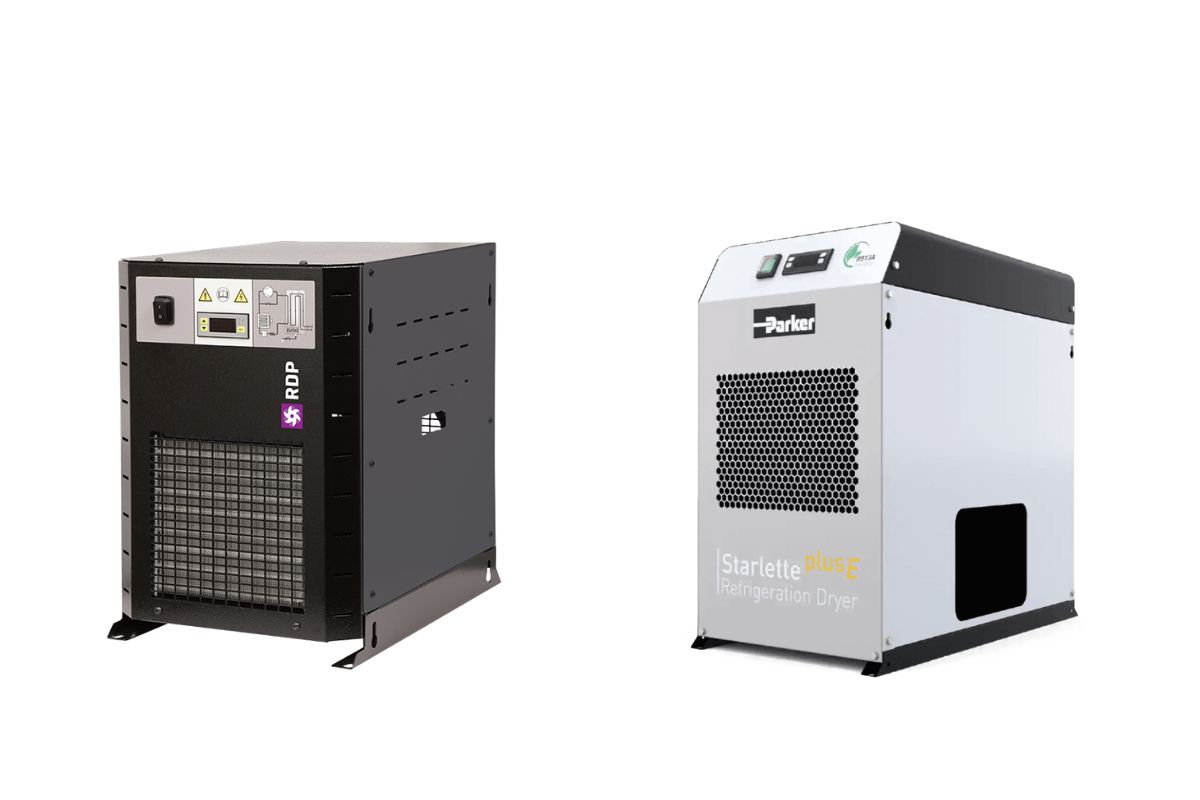
Refrigerated air dryers are the most widely used dryer type in general industrial applications. The principle is straightforward: incoming compressed air passes through a heat exchanger, where it’s cooled to around 3 °C. At that temperature, water vapour condenses into liquid water, which is then automatically separated and drained.
Refrigerated dryers are well-suited to workshops, manufacturing facilities, and general pneumatic applications in civil construction.
There are two sub-types worth understanding:
- Non-cycling refrigerated dryers run the refrigeration system continuously, regardless of air demand. They’re reliable and straightforward to maintain.
- Cycling refrigerated dryers modulate the refrigeration system based on load, which can reduce energy consumption during periods of lower demand (depending on the dryer model and operating profile).
| Pros | Cons |
|---|---|
| Low initial cost. | Temperature limitations (can’t achieve pressure dew points below 0°C). |
| Low operating costs, highly energy efficient and consume minimal power. | Do not remove close to 100% of the moisture, so they aren’t recommended for ultra-dry applications. |
| Low maintenance (just need to check drains and filters). | Performance degradation can occur in high surrounding ambient temperatures. |
Desiccant Air Dryers – Achieving Extremely Dry Air
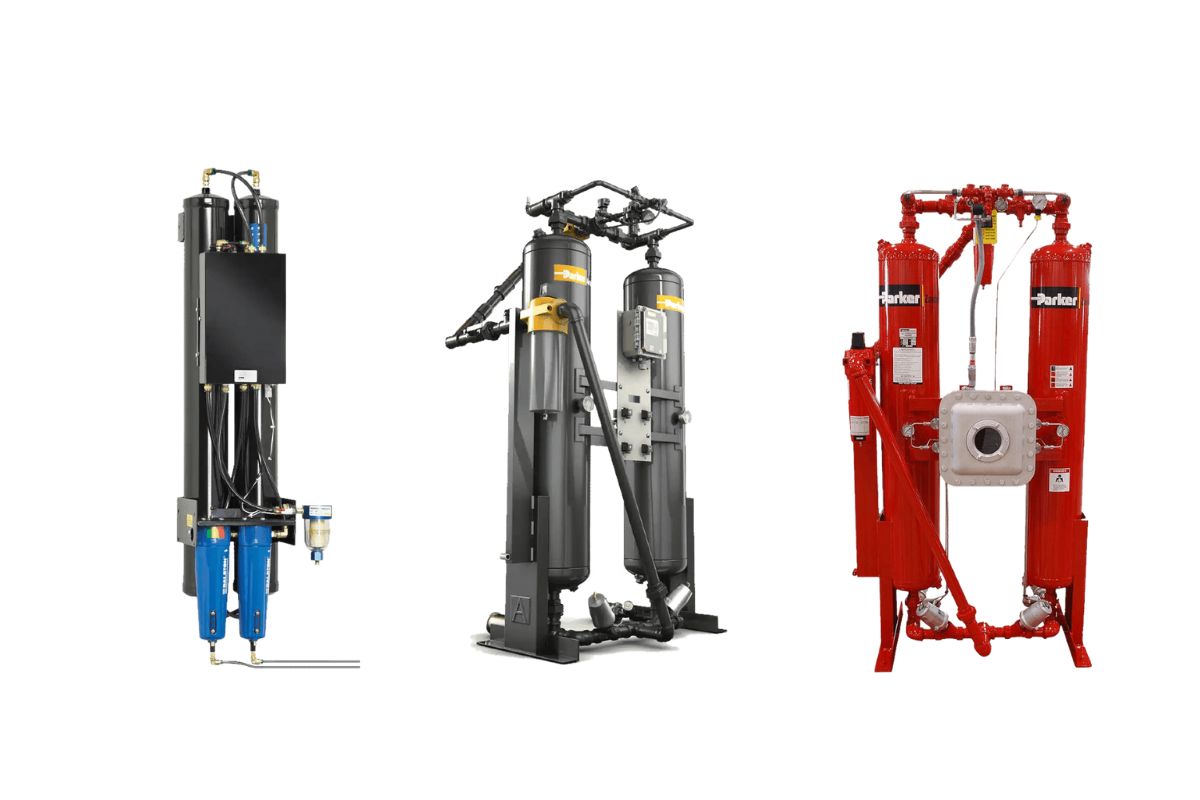
Where refrigerated dryers reach their limit, desiccant air dryers take over. These use a solid desiccant material (typically activated alumina or a silica gel) to adsorb moisture from the compressed air stream, delivering pressure dew points as low as -70 °C.
Most desiccant dryers use a twin-tower design. While one tower is actively drying the air stream, the other regenerates its saturated desiccant so it can cycle back into service.
This continuous operation means there’s no interruption to your air supply.
The main variants are:
- Heatless desiccant dryers use a portion of the dry compressed air (purge air) to regenerate the desiccant. Simple and reliable, but purge losses can reach 15-18% of total compressed air output.
- Heated desiccant dryers use internal or external heaters to assist regeneration, significantly reducing purge air losses.
- Heat-of-compression (HOC) dryers use the heat generated by compressors to regenerate the desiccant, achieving near-zero purge loss. These suit large, continuously operating systems such as food packaging plants.
Desiccant air dryers are commonly selected for applications requiring very low dew points, including certain food and beverage, pharmaceutical, instrument air, paint spraying and freezing-exposed systems.
| Pros | Cons |
|---|---|
| The most effective dryer for removing moisture. | Higher initial cost. |
| Extremely low dew points. | Desiccant materials may need to be replaced approximately every three to five years. |
| Suitable for a broad range of temperatures, including low-temperature applications, when correctly sized for the expected inlet and ambient conditions. | The regeneration process can consume a significant amount of energy. |
Membrane Air Dryers – Niche Solutions Explained
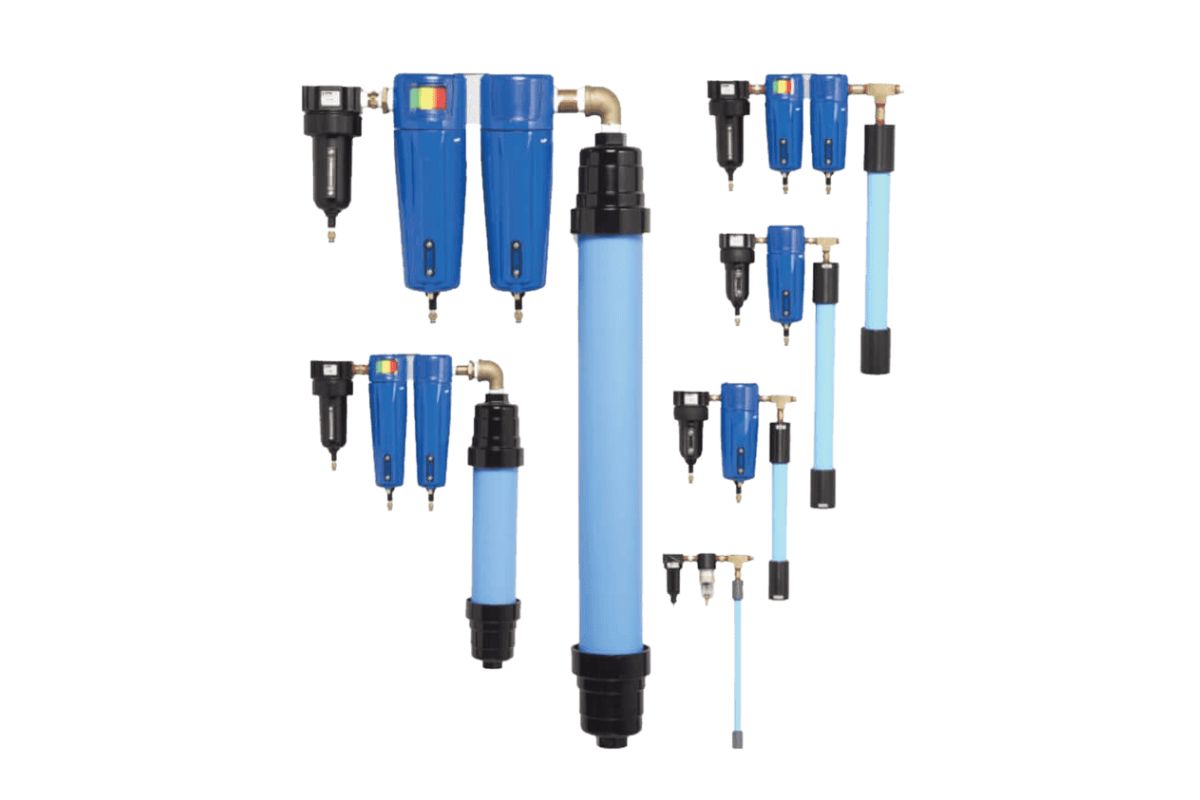
Membrane air dryers use a bundle of semi-permeable hollow-fibre tubes. Water vapour diffuses through the membrane wall and is swept away by a small counter-flow of dry air. They require no electrical power, no moving parts, produce no noise, and can achieve low-pressure dew points, with the exact performance depending on the model, inlet conditions and purge setting. Their flow capacity is limited, so they’re best suited to point-of-use applications, laboratory equipment, and medical devices rather than whole-system drying.
All types serve specific niches, and for most industrial compressed air applications, they’re not the primary solution. That said, membrane dryers are particularly useful for point-of-use applications in sectors such as medical, laboratory and electronics manufacturing.
| Pros | Cons |
|---|---|
| No moving parts and no electricity. | Requires properly filtered inlet air, with effective removal of particles, liquid water and oil aerosols to protect the membrane fibres. |
| Low maintenance from the absence of wear-and-tear components. | Flow rate restrictions. |
| Compact and flexible, making them ideal for hazardous environments where electrical devices are unsafe and for hard-to-reach areas. | Some models require 15–20% purge air to sweep the moisture away, meaning you are consistently losing a portion of your compressed air capacity. |
Choosing the Right Dryer for Your Operation
The cost of running an air dryer goes well beyond the purchase price. Electricity is one of the biggest ongoing expenses over the life of the system, so choosing an energy-efficient dryer can make a noticeable difference to your operating costs.
For example, a heatless desiccant dryer on a 100 kW compressed air system uses a portion of your compressed air for regeneration. Those purge losses add up over time. In many applications, switching to a heated or heat of compression (HOC) dryer can significantly reduce air consumption and lower energy costs as long as site and process conditions permit the use of these technologies.
Cycling refrigerated dryers can also deliver worthwhile savings, particularly in facilities where compressed air demand changes throughout the day. Rather than running continuously, they adjust their operation to match demand, reducing unnecessary energy use during quieter periods.
Meeting ISO 8573, AS 1715 and AS 2568 Standards
Not every application requires the same level of compressed air quality, which is why it’s important to choose a dryer that matches your operational and compliance requirements.
The international standard ISO 8573-1 classifies compressed air based on particle, water, and oil content, with different industries requiring different levels of air purity.
For example, food and beverage manufacturers often need to meet strict air quality classes to help protect product quality and support food safety requirements.
If your compressed air is used to supply breathing air for respiratory protective equipment, additional requirements also apply. AS/NZS 1715 provides guidance on respirator selection, use, maintenance, and the quality of the breathing air supplied.
Where compressed air is produced on site for medical use, AS 2568 also sets purity requirements that should be considered when selecting the dryer and filtration system.
Getting the Specification Right From the Start
Selecting the right dryer isn’t just about comparing product brochures. The operating environment, the required pressure dew point, the flow rate, the duty cycle, and the downstream application all influence the correct choice. In Western Australia’s hot, dusty conditions and on remote mine sites where access for servicing is limited, these factors carry even more weight.
Cleveland Compressors has been specifying, supplying, and servicing compressed air systems across Australia for over 30 years. If you’re working through a dryer selection or reviewing an existing system, speak to our team for practical, experienced advice.
Frequently Asked Questions
It depends on the application. Cycling refrigerated dryers are among the most efficient options for general industrial use.
For desiccant applications, heat-of-compression (HOC) dryers offer the lowest energy use by eliminating purge air losses almost entirely. The right choice depends on your system size, duty cycle, and required dew point.
If you are unsure, get in touch with our team today.
ISO 8573-1 water Class 2 corresponds to a pressure dew point of -40 °C or lower. Whether this class is required depends on the process, product-contact risk and applicable food safety requirements. This typically means desiccant drying combined with appropriate filtration. Your specific requirements may also depend on the relevant food safety certification your facility operates under.
In many cases, a central dryer serves the whole system, but point-of-use applications with tighter air quality requirements may need additional treatment at the point of use. A compressed air system audit can identify where targeted treatment makes more sense than upgrading the central dryer.